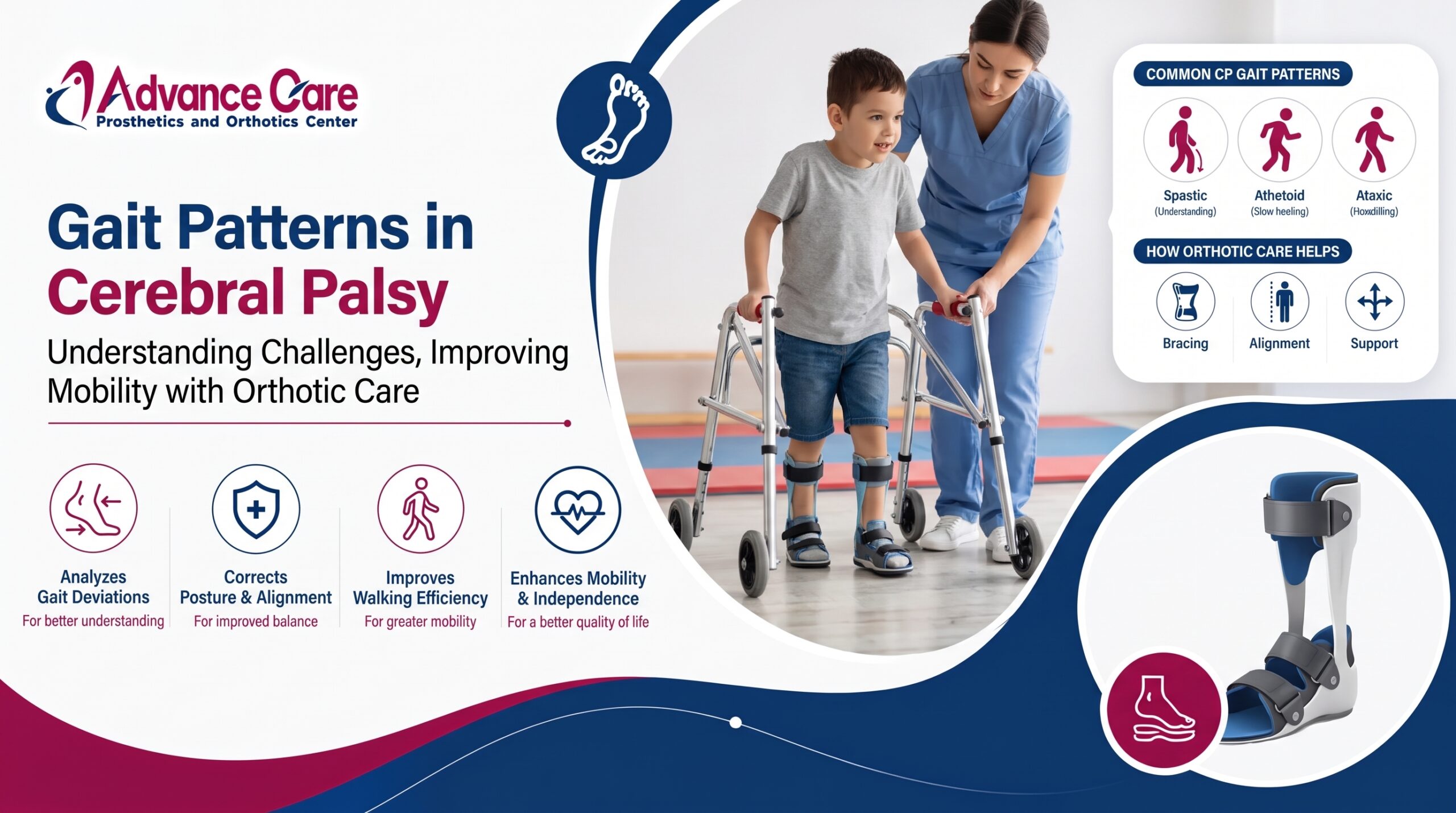
Cerebral palsy (CP) can affect walking in many different ways. Changes in muscle tone, muscle weakness, selective motor control, joint range of motion, skeletal alignment, and balance can all influence how a child stands and walks.
For this reason, there is no single orthotic solution for every child with cerebral palsy. Identifying the visible gait pattern is only the first step.
Effective orthotic management begins with understanding the child’s individual gait pattern and underlying biomechanics. A customized orthosis should not simply position the foot and ankle. It should support the entire lower-limb alignment and help improve functional movement.
Understanding Gait in Cerebral Palsy
A child’s gait pattern may change as they grow and may be influenced by spasticity, muscle contractures, weakness, skeletal deformity, surgical procedures, and rehabilitation.
Clinical gait assessment therefore considers the interaction between all the joints: foot, ankle, knee, hip, pelvis and trunk.
The position of the ankle can significantly influence the knee during standing and walking. This relationship is particularly important when designing and tuning an Ankle-Foot Orthosis (AFO).
1. Equinus or Toe-Walking Gait
Equinus gait is characterized by excessive plantarflexion of the ankle. Instead of making initial contact with the heel, the child may contact the ground with the forefoot or toes.
This pattern may contribute to reduced stability, difficulty clearing the foot during swing, and compensatory movements at the knee and hip.
The orthosis is customized to control excessive plantarflexion, improve initial contact, enhance foot clearance, and provide a more stable base for walking.
2. Jump Gait
Jump gait commonly presents with excessive ankle plantarflexion combined with increased knee and hip flexion. An increased anterior pelvic tilt may also be observed.
Although the child appears to walk on the toes, treatment should consider the position of the knee and hip rather than focusing only on the ankle.
A solid or appropriately articulated AFO may be used depending on the child’s clinical presentation. Careful AFO-footwear tuning can help control ankle position and tibial progression while influencing knee alignment during stance.
The objective is to create a more efficient relationship between the foot, ankle, knee, and ground-reaction force.
3. Crouch Gait
Crouch gait is characterized by excessive flexion of the hips and knees during stance, frequently accompanied by excessive ankle dorsiflexion.
Persistent crouching can increase the muscular demand required to maintain upright walking and may reduce walking efficiency.
A Ground-Reaction AFO or appropriately designed rigid AFO may be considered when clinically indicated. The orthosis is designed to control excessive tibial progression and optimize the relationship between the ground-reaction force and the knee.
AFO stiffness, ankle alignment, footwear, and Shank-to-Vertical Angle (SVA) should be considered together rather than treating the AFO as an isolated device.
4. Scissoring Gait
Scissoring gait is commonly associated with excessive hip adduction and internal rotation, creating a narrow base of support. In more pronounced cases, the legs may cross during walking.
AFOs can improve distal foot and ankle stability but cannot independently correct all proximal causes of scissoring.
Orthotic management therefore focuses on establishing a stable base of support and optimizing lower-limb alignment while working alongside physiotherapy, rehabilitation medicine, and orthopedic management when required.
Customized Orthotics: Beyond Holding the Ankle
Modern orthotic management in cerebral palsy goes beyond simply placing the ankle at 90 degrees. A customized orthotic prescription may consider:
- Joint range of motion
- Foot alignment
- Tibial progression
- Knee position
- SVA
- Footwear
- Growth
- Activity level
- Functional goals
Small changes in orthotic alignment or footwear can significantly alter how forces are transmitted through the lower limb. This is why AFO-footwear combination tuning is an important component of orthotic management for children with cerebral palsy.
Our Clinical Approach
At Advance Care Prosthetic and Orthotic Centre, orthotic intervention is based on an individualized clinical and biomechanical assessment. Our approach follows a structured pathway:
- Clinical Assessment
- Gait Analysis
- Identification of Primary Gait Deviation
- Orthotic Prescription
- Customized Fabrication
- AFO-Footwear Tuning
- Dynamic Gait Assessment
- Follow-Up and Adjustment
As children grow and their functional abilities change, their orthotic requirements may also change. Regular follow-up allows the orthosis to be adjusted or replaced when necessary to maintain appropriate alignment, comfort, and function.
The Goal: Better Movement, Not Simply Better Position
The objective of customized orthotic intervention in cerebral palsy is not simply to make the foot look straight.
The goal is to create an appropriate biomechanical environment that can help the child achieve greater stability, improved alignment, more efficient movement, safer mobility, and greater functional independence.
Every child with cerebral palsy presents differently. Their orthotic intervention should be equally individualized.