By Rabia Arshad, CPO | Advance Care Prosthetic and Orthotic Center
Rehabilitation is a team effort. A patient may work with physicians, physiotherapists, occupational therapists, nurses, orthotists, caregivers, and other healthcare professionals. Each member contributes a different area of expertise, but the ultimate focus should remain the same: helping the patient achieve meaningful functional goals and improve quality of life.
As an orthotist at Advance Care, my role extends beyond selecting, designing, and fitting an orthosis. It involves understanding the patient’s condition, listening to their concerns, communicating with the multidisciplinary team, and developing an orthotic solution that supports the patient’s individual rehabilitation goals.
Every orthotic intervention should begin with one important question: What does the patient need to achieve?
The purpose of an orthosis can be very different from one patient to another. For one patient, the goal may be to improve walking safety. For another, it may be to maintain joint alignment, protect a postoperative area, manage a contracture, improve standing balance, reduce pain, or increase independence in daily activities. For a child, the priority may be supporting development and participation in school and play.
Therefore, the orthosis should be prescribed according to the patient’s functional purpose, rather than simply according to the diagnosis.
Understanding the Patient’s Purpose
Before recommending an orthosis, the orthotist should understand:
- What activity is difficult for the patient?
- What movement needs to be supported or controlled?
- What does the patient want to achieve?
- What are the rehabilitation goals?
- What activities does the patient perform at home, work, or school?
- What footwear does the patient use?
- Can the patient independently put on and remove the orthosis?
- What concerns does the patient or caregiver have?
The Orthotist as Part of the Multidisciplinary Team
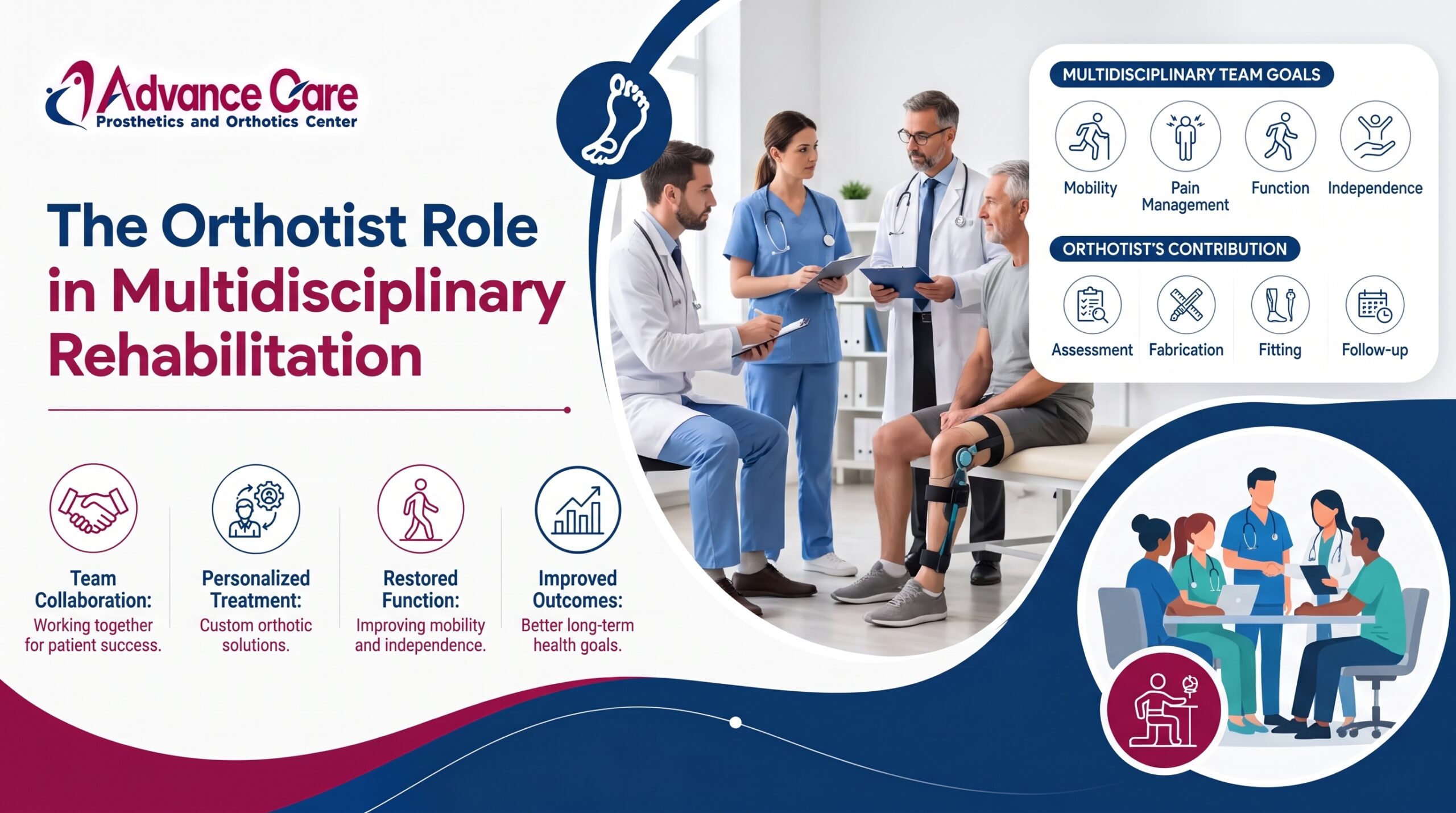
At Advance Care, orthotic management can involve communication with different healthcare professionals depending on the patient’s needs. The orthotist may collaborate with:
- Orthopedic surgeons
- Rehabilitation physicians
- Physiotherapists
- Occupational therapists
- Neurologists
- Pediatricians
- Nurses
- Prosthetists
- Caregivers
- Patients and families
This collaboration helps ensure that the orthosis supports the overall rehabilitation plan rather than functioning as an isolated intervention.
Working With Physiotherapists
Physiotherapists provide valuable information regarding movement, muscle strength, balance, gait, transfers, and functional performance.
Working With Physicians and Surgeons
Orthotists also work closely with physicians and surgeons, particularly for postoperative and orthopedic patients. Examples include:
- Postoperative AFOs
- Fracture bracing
- Knee and ankle instability
- Tendon injuries
- Scoliosis
- Pediatric deformities
- Joint protection
Medical information such as diagnosis, surgical procedure, healing status, weight-bearing restrictions, and precautions is essential when developing the orthotic plan. The orthotist then considers how the device can provide the required support while allowing the patient to progress safely through rehabilitation.
Orthotics in Neurological Rehabilitation
Patients with neurological conditions may have combinations of weakness, spasticity, contractures, altered motor control, balance problems, and gait abnormalities. Examples include:
- Cerebral palsy
- Stroke
- Muscular dystrophy
- Spinal cord injury
- Multiple sclerosis
- Peripheral nerve disorders
The purpose of orthotic intervention may be to:
- Improve foot clearance
- Increase stability
- Control unwanted movement
- Maintain range of motion
- Support standing
- Assist gait training
The Patient and Family Are Part of the Team
Multidisciplinary rehabilitation should be patient-centered. Patients and caregivers provide information that may not be visible during a clinical assessment. They can explain:
- What activities are difficult
- When discomfort occurs
- How long the orthosis is worn
- What happens at home
- What footwear is available
- What barriers prevent regular use
- What outcomes matter most to them
For pediatric patients, caregiver education and cooperation are especially important. An orthosis can be biomechanically appropriate, but if the patient cannot comfortably use it during daily activities, its real-world benefit may be limited.
From Assessment to Orthotic Solution
The orthotist’s clinical process can be viewed as:
- Patient concern
- Clinical assessment
- Rehabilitation goal
- Orthotic objective
- Design
- Fabrication
- Fitting
- Functional assessment
- Follow-up
Each step is connected. For example, if the patient’s goal is safer walking, the orthotist should assess not only the foot and ankle but also the patient’s knee, hip, balance, gait pattern, footwear, and overall functional ability.
Follow-Up and Team Communication
Orthotic treatment does not end at delivery. Follow-up allows the orthotist to evaluate:
- Comfort
- Skin condition
- Alignment
- Suspension
- Function
- Gait
- Patient satisfaction
- Changes in the patient’s condition
- Need for modification
Feedback from physiotherapists, physicians, caregivers, and the patient can help determine whether the orthosis is achieving its intended purpose. Sometimes the solution may be a simple modification. Sometimes the patient’s clinical condition has changed and the orthotic design needs to be reconsidered.
The Orthotist’s Role at Advance Care
At Advance Care, orthotic care can be viewed as a combination of clinical knowledge, biomechanics, technical expertise, communication, and patient-centered care.
Final Thoughts
The success of an orthosis should not be measured only by how well it fits. It should also be measured by what it allows the patient to do. Whether the goal is taking the first independent steps, walking more safely, returning to work, participating in school, protecting a healing joint, maintaining alignment, or becoming more independent in daily activities, the patient’s purpose should remain at the center of the orthotic process.
As orthotists, our responsibility is to connect the two through careful assessment, clinical reasoning, multidisciplinary communication, and continuous follow-up.
Rabia Arshad, CPO
Advance Care, Orthotist