Losing an upper limb whether at the forearm (transradial) or upper arm (transhumeral) level presents an immediate, complex challenge to a person’s ability to interact with their world. Everyday tasks we take for granted, such as preparing meals, typing, using tools, or carrying objects, suddenly require a complete rethink of movement strategies. Modern upper extremity prosthetics offers exceptionally advanced options designed to restore functional hand capabilities and bring balance back to a patient’s life. When selecting a device, individuals must navigate a key choice between two distinct technological worlds: traditional body-powered systems and advanced electronic myoelectric designs. Each approach features unique mechanical benefits, controls, and lifestyle trade-offs. This clinical guide provides a comprehensive comparison of body-powered and myoelectric technologies, helping you choose the ideal system to match your occupational needs and goals.
Understanding Body-Powered Harness Systems
Traditional body-powered prostheses have served as a reliable option for decades, utilizing a system of physical cables and straps to capture upper body movement.
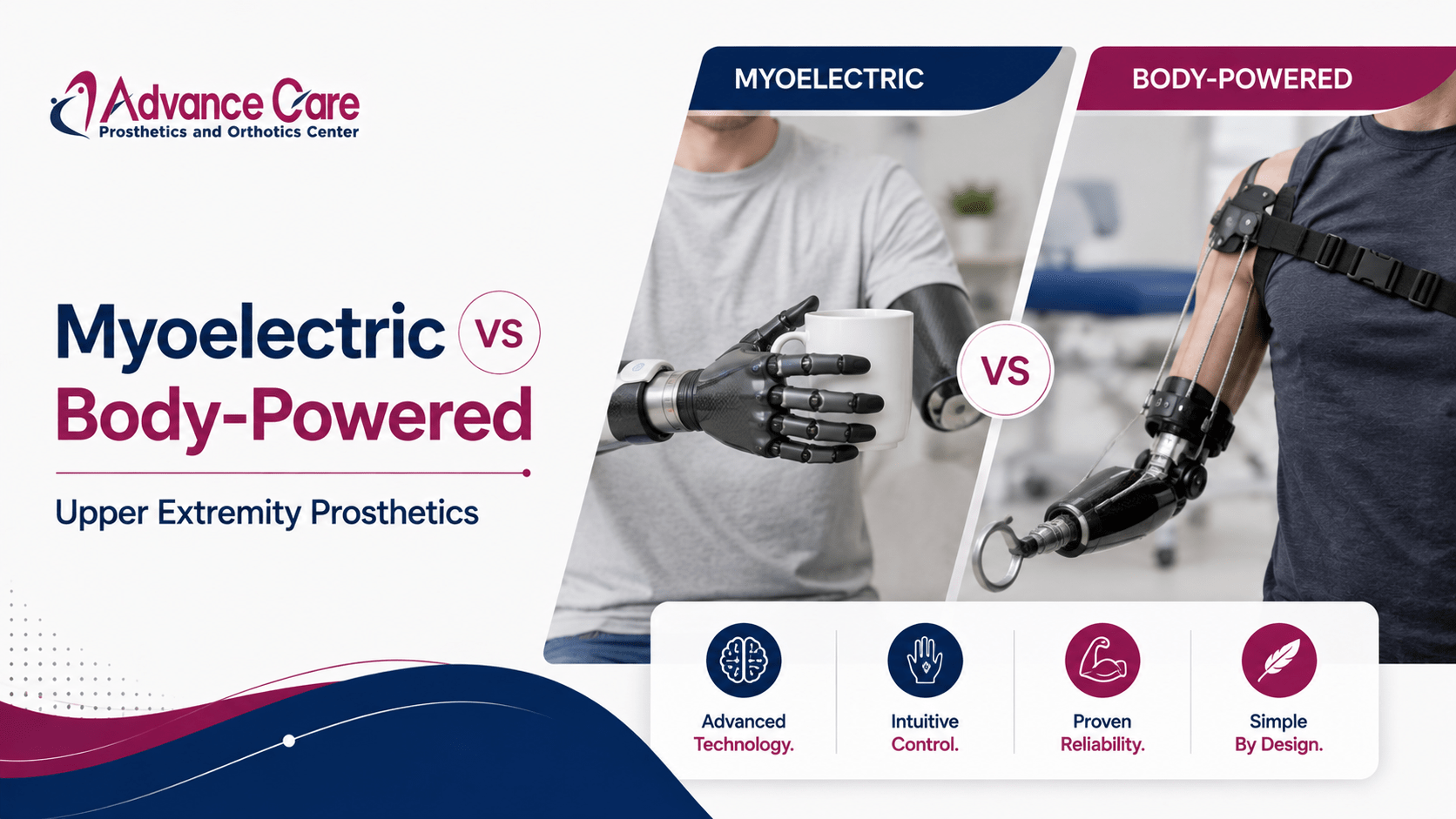
- The Structural Harness Layout: The device anchors to the body using a cross-shaped fabric harness that wraps around the shoulders and upper back. A high-strength stainless steel cable extends from this harness down the arm to connect directly to the prosthetic hook or hand.
- Kinematic Cable Control: To open or close the terminal device, the patient performs specific upper body movements such as pulling their shoulders forward or extending their arm. This motion pulls the cable tight, mechanically moving the hook. This direct connection provides the user with an intuitive sense of how much force they are applying, allowing for quick, reliable control over everyday objects.
Exploring Advanced Myoelectric Technology
Representing a major leap forward in prosthetic engineering, a myoelectric hand prosthesis utilizes modern micro-electronics to achieve natural, intuitive hand movements.
- Advanced Surface Sensor Arrays: Small electromyography (EMG) sensors are embedded directly within the walls of the custom plastic socket, resting gently against the skin of the residual limb.
- Detecting Muscle Signals: When the user thinks about moving their hand, the remaining muscles in their arm contract naturally. The sensors instantly detect these tiny electrical signals from the skin’s surface.
- Powering Robotic Terminals: An internal computer processor analyzes these muscle signals and translates them into commands that activate a high-tech battery pack. This power drives motorized fingers, enabling precise tasks like pinching a pen or holding a cup securely.
Head-to-Head Architectural Comparison
Selecting the ideal prosthesis requires evaluating the key trade-offs between rugged simplicity and advanced electronic capability.
| Operational Feature | Body-Powered Harness Systems | Advanced Myoelectric Prostheses |
| Primary Power Source | Manual muscle force from the shoulders and back. | Rechargeable internal lithium-ion battery pack. |
| Grip Control Variety | Single open-and-close grip pattern via a split-hook. | Multiple advanced grip patterns (pinch, point, key grip). |
| Rugged Environmental Use | Exceptionally durable; highly resistant to water, dirt, and dust. | Sensitive to water and dust; requires careful handling. |
| Aesthetic Presentation | Features a distinct mechanical, industrial appearance. | High-end anatomical look; can be covered with realistic skin. |
| Physical Effort Required | Requires continuous shoulder movement, which can cause fatigue. | Exceptionally low physical effort; driven by subtle muscle twitches. |
Maximizing Success with Transradial Rehabilitation
Regardless of the technology selected, learning to use an upper limb prosthesis effectively requires a structured rehabilitation program guided by an occupational therapist.
- Functional Task Practice: Therapy transitions to practicing everyday activities, teaching patients how to position their elbow and wrist correctly to grasp objects from tables or shelves.
- Phased Signal Training: For myoelectric users, early therapy sessions focus on practicing muscle control, learning to isolate specific muscle flexes without moving the entire arm to trigger the sensors reliably.
- Routine Joint Maintenance: Harness straps can stretch out and battery performance can decline over months of use. Regular visits to your prosthetist ensure cables remain tight, sensors stay aligned, and joints move smoothly.
Frequently Asked Questions
Which upper limb prosthesis type is better for heavy-duty manual labor and outdoor work?
Body-powered harness systems are ideal for manual labor, construction, and farming. Their steel cables and mechanical hooks can handle heavy lifting and remain completely unaffected by mud, water, or dust.
How many hours does a myoelectric prosthesis battery pack typically last on a charge?
Modern myoelectric batteries are designed to support a full day of typical activity, lasting between twelve and sixteen hours on a single charge. Users plug the device into a standard wall charger overnight.
Can an upper extremity prosthesis restore the natural sensation of touch?
Standard prostheses do not provide direct sensory feedback to the nerves. However,
body-powered users experience “proprioception” feeling the tension of the cable against their back, which tells them how wide the hook is open. Advanced research into myoelectric sensory feedback is ongoing but not yet a standard feature.
Is it difficult to learn how to operate a myoelectric multi-articulating robotic hand?
Most patients learn the basic muscle contractions within a few hours. Mastering advanced grip patterns and fine coordination typically requires three to six months of dedicated occupational therapy practice.
Can an individual combine both technologies throughout their recovery journey?
Yes, many active upper limb amputees utilize a multi-device strategy, using a rugged body-powered device for sports, gardening, or messy chores, and switching to an advanced myoelectric hand for office work and social gatherings.
Conclusion
Navigating upper limb loss requires a personalized, forward-looking approach to prosthetic technology and everyday function. Utilizing advanced upper extremity prosthetics delivers an exceptionally effective way to rebuild independence and perform complex daily tasks with ease. Whether choosing a rugged body-powered harness system for its durability and intuitive feedback, or an advanced myoelectric hand for its natural controls and varied grip options, modern engineering offers incredible tools to support your goals. Work closely with an experienced team of prosthetists and occupational therapists to design, build, and master your personalized prosthesis, ensuring a confident return to an active and fulfilling life.