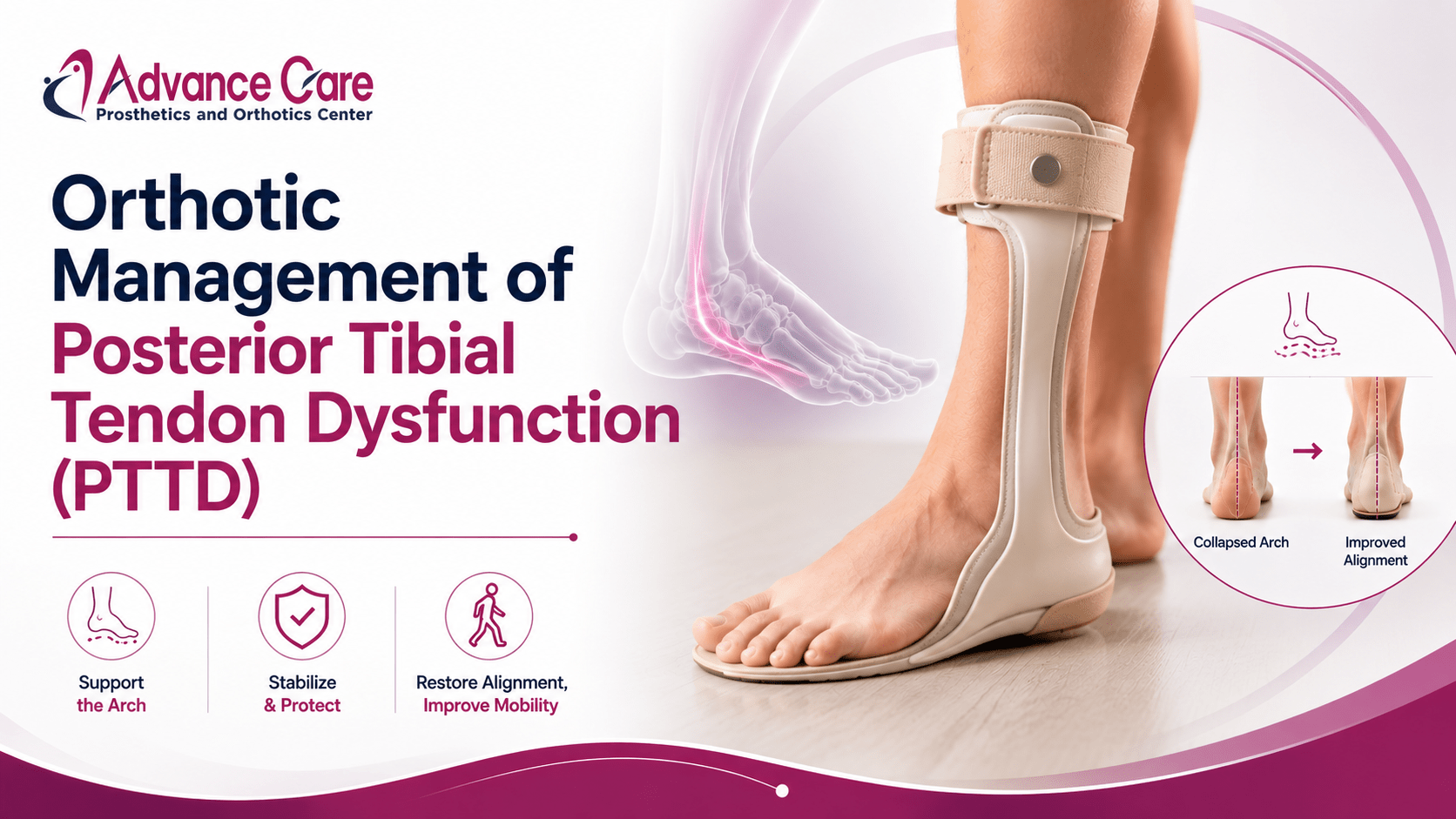
Posterior Tibial Tendon Dysfunction (PTTD) is a progressive, debilitating musculoskeletal condition that serves as the leading cause of adult acquired flatfoot deformity. The posterior tibial tendon plays a vital role in lower limb mechanics, traveling down the inside of the ankle to support the foot’s natural longitudinal arch and stabilize the midfoot during walking. When this tendon experiences chronic inflammation, micro-tears, or structural degeneration, it gradually loses its ability to hold up the foot, leading to a painful collapse of the entire arch structure. Managing this breakdown effectively requires early, targeted pttd orthotic treatment to slow down the condition and protect joint health. Depending on how far the dysfunction has progressed, customized solutions—ranging from rigid, deep-heeled UCBL foot orthotics to leather-lined ankle-foot orthoses are required to realign the hindfoot, lift the arch, and relieve chronic tension on the damaged tendon.
The Pathomechanics of Progressive Arch Collapse
PTTD progresses through distinct, predictable stages that alter the alignment and function of the entire lower limb if left unmanaged.
In the early stages, the tendon becomes swollen and tender along the inside of the ankle, making it difficult or painful for the patient to perform a single-leg heel raise.
As the tendon weakens further, the arch collapses inward into severe over-pronation. This structural shift forces the heel bone to tilt outward into a valgus position, while the front of the foot turns out. Over time, these flexible misalignments can harden into a rigid, arthritic deformity that makes every step painful.
Custom Orthotic Tier Matrix for PTTD Stages
Orthotic management must match the specific stage and flexibility of the patient’s foot deformity to provide optimal support and pain relief.
| PTTD Progression Stage | Recommended Orthotic Design | Primary Biomechanical Mechanism |
| Stage I (Mild Inflammation) | Custom Foot Orthotic with Medial Post | Lifts the internal arch subtly; reduces mild alignment strain on the tendon. |
| Stage II (Flexible Flatfoot) | Custom UCBL Foot Insert | Features extra-deep heel walls to grip the heel bone and block inward rolling. |
| Stage III (Rigid Deformity) | Molded Leather-Lined Custom AFO | Encased plastic shell immobilizes the ankle joint, eliminating painful bone friction. |
Biomechanical Principles of Custom UCBL Inserts
Named after the University of California Biomechanics Laboratory, the custom UCBL insert is an exceptionally effective device for managing flexible Stage II flatfoot.
- Deep Lateral and Medial Walls: Unlike standard arch supports, a UCBL insert features high, rigid plastic walls that wrap around the heel, firmly holding the calcaneus bone to prevent it from tilting outward.
- Integrated Medial Arch Apposition: The brace is molded to fit tightly against the sustentaculum tali—a supportive bony shelf on the inside of the heel—providing a direct physical lift to the arch.
- Forefoot Correction Controls: The front extension applies a gentle outward pressure against the outside of the foot, counteracting the inward twisting motion caused by tendon weakness.
Comprehensive Non-Surgical Care and Rehabilitation
Achieving long-term relief from PTTD requires a well-rounded care plan that combines custom orthotic support with structured physical rehabilitation.
- Targeted Eccentric Strengthening: Working with a physical therapist on specialized, slow exercises for the posterior tibial muscle helps rebuild tendon resilience and strength.
- Stretching the Calf and Achilles Complex: Tight calf muscles place heavy forward loads on the foot, pulling down the arch. Daily stretching reduces this structural tension, protecting the midfoot.
- Supportive Extra-Depth Footwear: A custom UCBL or AFO brace must be paired with deep, stable footwear featuring a rigid shank and a firm heel counter to optimize the brace’s corrective forces.
Frequently Asked Questions
Can an off-the-shelf arch support effectively manage advanced PTTD?
No, standard off-the-shelf inserts lack the deep heel cup and structural strength required to control a collapsing hindfoot bone structure. Advanced PTTD requires a custom-molded UCBL insert or an AFO to apply the precise, rigid forces needed to stabilize the joints.
How long does a patient typically need to use pttd orthotic treatment?
Because PTTD is a chronic, degenerative condition, most patients use their custom orthotic devices over the long term during all walking activities to maintain stable alignment and prevent the deformity from returning or worsening.
Is it possible to reverse a collapsed arch without undergoing surgery?
Custom orthotics cannot surgically alter or reverse permanent bone changes that have already occurred, but they can successfully support a flexible flatfoot, stop a progressive deformity from worsening, and eliminate chronic pain.
What is a leather-lined custom AFO, and when is it necessary for PTTD?
A leather-lined custom AFO (often called a Richie Brace or Arizona Boot) features a plastic shell wrapped in soft, comfortable leather. It is prescribed for advanced, rigid Stage III PTTD to restrict painful movement across the ankle and midfoot joints completely.
What signs indicate that my custom PTTD brace needs a structural adjustment?
You should visit your orthotist for an adjustment if you notice localized skin redness or calluses along the inside ankle bone that do not fade within twenty minutes of taking off the brace, or if you experience a return of arch pain.
Conclusion
Successfully managing Posterior Tibial Tendon Dysfunction requires a deep understanding of foot biomechanics and timely, specialized orthotic care. Implementing a personalized pttd orthotic treatment plan delivers the essential structural stabilization needed to support a collapsing arch, realign an outward-tilting heel, and reduce chronic tendon strain. Whether using a custom UCBL insert to manage a flexible flatfoot or a leather-lined AFO to secure a rigid joint, these precision devices protect your long-term mobility. Work closely with a skilled team of podiatrists and certified orthotists to design, build, and maintain your custom orthotics, helping you step forward with comfort and stability.