THE STORY OF PATIENT B

  • Blog
  • January 10, 2022

Self-consciousness about one’s appearance is nearly a rite of passage for today’s youth, but for those with pectus carinatum, that anxiety can be amplified significantly. Pectus carinatum, often known as ‘pigeon chest,’ is a congenital deformity of the anterior chest wall caused by an abnormal overgrowth of cartilage pushing the breast bone outward, creating apparent protrusion of the bone and, in certain cases, additional accompanying symptoms such as respiratory issues. It affects about one in every 1,500 people, and while it is present at birth, it is most evident during early adolescence when the ribcage and the rest of the body go through puberty development spurts.
“He was 14 at the time and was eager to find a non-surgical treatment option to improve the appearance of his chest wall,” says LOC clinician Sam Walmsley.” His age made him an ideal candidate for our non-surgical LOCpectus treatment, as the chest is more malleable in adolescents than adults, becoming stiffer as the skeleton matures, which can make results harder to achieve.

After being offered only surgical solutions on the NHS, a 14-year-old pectus patient came to The London Orthotic Consultancy for treatment for his pectus carinatum inferior with rib flaring. While this is a well-established type of treatment, it comes with the risks of undergoing a general anaesthesia, does not solve the problem of rib flaring, and patients may be left with noticeable scars.

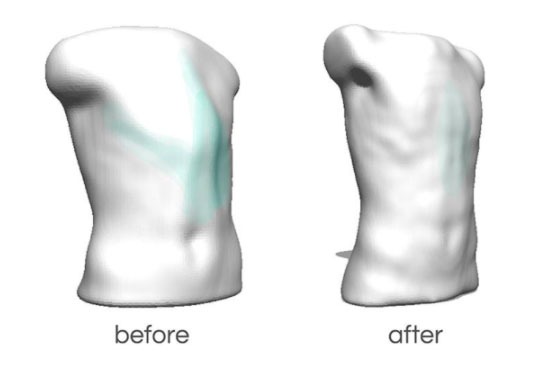
The Dynamic Chest Compressor, a custom-made brace, was used to apply continual pressure to the area of his chest that needed to be remodelled in this young man’s treatment. We employ a brace that goes over the apex of the chest to push it in – the dynamic chest compressor 1 – for the upper chest since pectus carinatum is caused by the chest protruding. The lower dynamic chest compressor 2 is also required in circumstances where the ribs protrude, as in this case. The ribs flare out when the upper chest is pushed inwards, so we employ this lower brace to pull them back in. In addition, he was given a daily fitness routine to follow.”

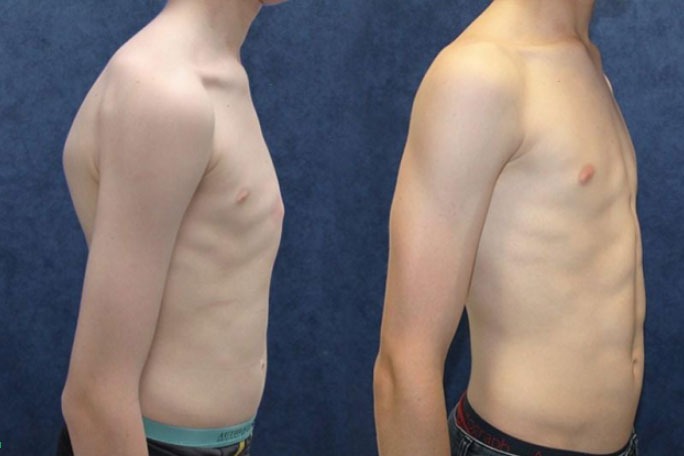
Length of treatment varies depending on the age of the patient, the elasticity of the chest and the severity of the condition. “His treatment here at The London Orthotic Consultancy lasted a period of 15 months, however, he successfully achieved a flat chest after only six months [see before and after photographs which show significant improvement],” says Sam. “The remaining nine months consisted of night-time brace use only, in order to maintain the much-improved appearance throughout his growth spurts.”
In this young man’s treatment, the Dynamic Chest Compressor, a custom-made brace, was utilised to deliver constant pressure to the area of his chest that needed to be rebuilt. Because pectus carinatum is caused by the chest protruding, we utilise a brace that goes over the apex of the chest to push it in – the dynamic chest compressor 1 – for the upper chest. When the ribs protrude, as they do in this situation, the lower dynamic chest compressor 2 is also required. When the upper chest is pressed inwards, the ribs flare out, so we use this lower brace to draw them back in. He was also given a regular workout regimen to follow.”

Recent Blog

CHENEAU BRACE

  • February 5, 2022

CEREBRAL PALSY & ORTHOTICS

  • January 30, 2022

CONDITIONS OF FEMALE PECTUS

  • January 20, 2022

Related Blogs

    AN ANNOUNCEMENT REGARDING SCOLIOSIS

    • Blog
    • February 8, 2022
    Read More

    CHENEAU BRACE

    • Blog
    • February 5, 2022
    Read More

    CEREBRAL PALSY & ORTHOTICS

    • Blog
    • January 30, 2022
    Read More

    CONDITIONS OF FEMALE PECTUS

    • Blog
    • January 20, 2022
    Read More