When a child is diagnosed with scoliosis before age 10, it is not just a smaller version of the curve we see in teenagers. It is a different disease entirely, one where the clock is ticking on growth, and where the stakes reach far beyond a crooked spine.
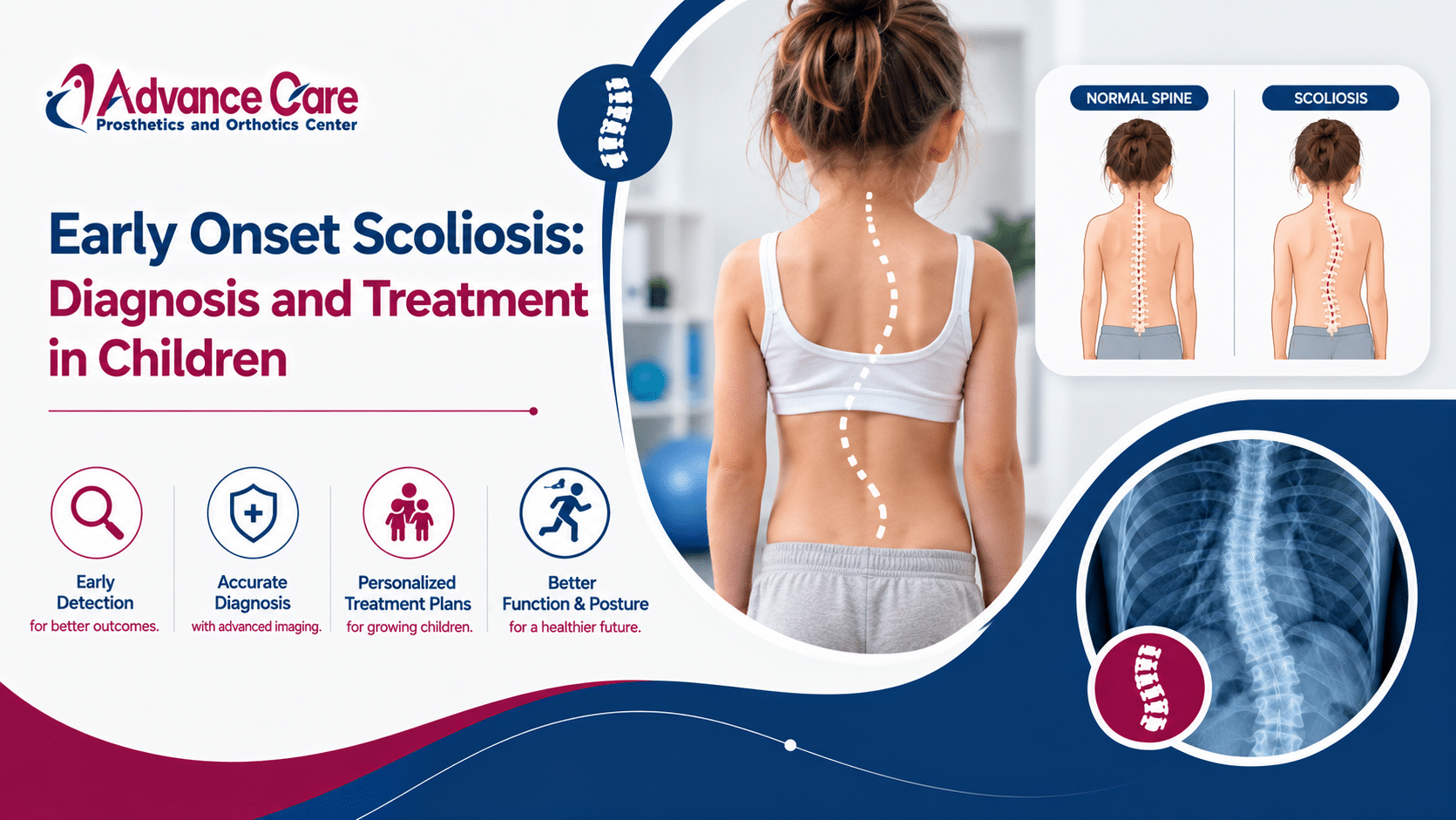
Early onset scoliosis (EOS) means a spinal curve greater than 10 degrees appearing before age 10. The key word is before. At that age, the spine, the chest, and the lungs are all still under construction. That changes everything.
The Lung Problem Nobody Sees Coming
Here is what makes early onset scoliosis so serious: the chest has to grow for the lungs to grow. Alveoli, the tiny air sacs where oxygen enters the blood, multiply rapidly through early childhood. If a spinal curve squeezes the chest and stops it from expanding, those alveoli never form. The result is thoracic insufficiency syndrome, a chest that simply cannot support normal breathing.
This is why we treat EOS so differently from adolescent scoliosis. In a teenager, the goal is a straighter spine. In a young child, the goal is keeping the spine and chest growing while controlling the curve. Straightening the spine at the cost of lung development is a pyrrhic victory.
What Causes Early Onset Scoliosis?
EOS is not one disease, it is a group of conditions. The EOS classification sorts patients by age, cause, curve size, and kyphosis. Causes include:
- Congenital: vertebrae that did not form properly in the womb
- Idiopathic: no clear cause
- Neuromuscular: conditions like cerebral palsy or spinal muscular atrophy
- Syndromic: part of a wider genetic syndrome
Diagnosis and Assessment of Early Onset Scoliosis (EOS)
The initial diagnosis and ongoing assessment require a thorough physical evaluation, detailed medical history, and specific medical imaging, as EOS is frequently secondary to underlying conditions (neuromuscular, syndromic, or congenital).
Diagnostic Medical Imaging
Imaging is required to confirm the scoliosis diagnosis, quantify the curve, and assess potential underlying anomalies:
- Standing or Supine Radiographs (X-rays): Anterior-Posterior (AP) and lateral view X-rays of the entire spine and pelvis are used to measure the Cobb angle (the degree of spinal curvature).
- MRI (Magnetic Resonance Imaging): MRI is often recommended in EOS, especially in very young patients or those with rapid curve progression, atypical curves, or abnormal neurological findings. It is essential to screen for spinal cord or brain anomalies such as syrinx, tethered cord, or Chiari malformation, which can cause scoliosis.
Clinical Physical Examination
The physical exam is crucial for identifying structural asymmetries in the trunk, back, and pelvis. Key assessment methods include:
- Observation: Visualizing the child’s back while they stand, looking for unlevel shoulders, a prominent hip, asymmetrical waist folds, or rib cage prominence (hump).
- Adams Forward Bend Test: The child bends forward from the waist as if to touch their toes. A clinician observes the back from a posterior and tangential view. This position makes spinal rotation and rib cage prominence more visible, allowing for initial screening and assessment.
- Neurological Screening: A comprehensive neurological evaluation is mandatory to rule out neuromuscular causes (for example tethered cord, cerebral palsy, spinal muscular atrophy), assessing reflexes, muscle tone, and gait abnormalities.
How We Treat It and Why the Old Way Failed
Years ago, surgeons fused the spine early to straighten the curve. It worked on the X-ray. But the children paid a terrible price. Their spines stopped growing. Their chests stayed small. Their lungs never caught up. Early fusion has since been abandoned for EOS.
Today, the guiding principle is growth friendly treatment: control the curve without stealing growth.
Non-Surgical Options for Early Onset Scoliosis
The Role of Bracing in Early Onset Scoliosis
Bracing in young children serves several critical functions:
- Halting or Delaying Curve Progression: By exerting gentle, targeted pressure on the developing trunk, a custom 3-dimensional brace helps control progressive curves during rapid growth phases.
- Delaying or Avoiding Surgery: Every year a young child avoids spinal surgery is a year of uninterrupted natural growth and lower complication risks. Effective bracing can often delay surgical intervention until the spine is much more mature, or even eliminate the need for surgery altogether in mild-to-moderate cases.
- Complementing Serial Casting: For infants and toddlers with very young, flexible spines, Mehta casting (EDF) is often used first to reduce the curve, followed by transitional bracing to maintain those corrections comfortably as the child grows.
While bracing requires high compliance and careful custom fitting, it remains one of the safest, non-invasive tools available for managing young spines.
Growth-Friendly Surgery
When curves progress despite casting, surgery may be needed.
The Burden Families Carry
It is easy to focus on X-rays and surgeries. But EOS is a family affair. Casts, braces, repeated operations, long drives to clinic, the toll is real. Decision-making has to weigh the spine against the child’s quality of life. Sometimes the best treatment is the one the family can actually live with.
What Clinicians Should Remember
- Age of onset matters more than curve size. EOS threatens the lungs in ways adolescent scoliosis does not.
- Earlier detection means gentler treatment. Bracing works best in young, flexible curves.
- Growth is the goal. Premature fusion risks a chest that cannot breathe.
- Every option has trade-offs. Complications are common across the board.
- It takes a team. Orthopaedics, pulmonology, orthotist, therapists, and psychosocial support all matter.
Conclusion
EOS is one of the hardest problems in paediatric orthopaedics. We have learned the hard way that straightening a spine too early can cost a child their breath. The field has moved on, but the best growth friendly strategy, and the right time to stop, are still being written.
Call to action (optional, edit as needed): If you are concerned about your child’s spine, contact Advance Care Prosthetics and Orthotics Center to book an early assessment.